Site the fire with the shelter in mind. The manual wants a dry spot protected from the wind, placed in relation to your shelter so it concentrates the heat where you want it, with a supply of wood nearby. A spot out of the wind keeps the fire steady and stops embersember A small piece of glowing, burning material with no flame. Fold it into tinder and blow gently to make fire. from blowing onto the shelter. Placed in front of the open side, the fire sends heat where you sit and sleep. Gather plenty of wood before dark; the cold weather manual says to collect enough to last all night.
Shelter · Shelter course
A fire in front of the shelter, and a wall to bounce the heat
An open-fronted shelter and a fire belong together, but a fire in the wrong place burns the shelter, fills it with smoke or sinks into the snow. The manuals give a reflector wallreflector A low wall of logs or rocks on the far side of a fire that bounces its heat back toward you. of green logsgreen wood Wood cut from a living tree, still full of sap. It will not burn easily, which is why it makes the base under a fire on snow and the reflector wall behind one. for the lean-to, a fire wall for any fire, and a log fire that burns all night in deep snow.
Why this matters
An open-front shelter and a fire work as a team. The fire warms the open side, and a reflector wall behind the fire turns heat that would go into the woods back toward you. The manual also uses the wall to block wind and cut down on flying sparks.
Fire near a shelter is also the easiest way to lose the shelter. Sparks can light a roof of dry leavesdebris Dry leaves, pine needles, grass and ferns. Piled deep they trap still air, which is what keeps you warm., a fire can creep through the ground and come up somewhere else, and in a snow shelter too much heat melts the walls. Placing the fire well and keeping it small is what makes it safe.
What you need
- For any fire: a dry, cleared spot, tindertinder The driest, finest material you have, which catches a spark or small flame: shredded inner bark, dry grass, birch bark curls, cattail fluff., kindlingkindling Pencil-thin dead twigs that catch from tinder and build the fire up. They should snap, not bend. and fuelfuel wood Dead wood from finger to wrist thick that keeps the fire going once the kindling has caught., a way to light it, and water or dirt nearby to put it out. Only where fires are legal and safe.
- For a reflector wall: four stakes about 5 feet (1.5 meters) long, green logs to stack, dirt to fill between the rows, and cord or vines to tie the stake tops.
- For a drying rack: a few polespoles Dead, straight sticks about as thick as your wrist and 2 to 3 meters long. Dead standing wood is best: dry, and it snaps clean. about 3/4 inch (2 centimeters) thick and smaller sticks to tie across them.
Step by step
Clear the brush and scrape the surface soil from a circle at least 3 feet (1 meter) across so the fire cannot spread. Scrape away leaves, grass and the top layer of soil until you see bare dirt in a circle at least 3 feet (1 meter) across. Dry leaves and roots can carry a fire away from where you built it. You did it right when nothing in the circle can catch.
If time allows, build a fire wall of logs or rocks. It reflects and directs the heat, cuts down flying sparks and blocks wind, though the fire still needs some wind to burn. Never use wet or porous rocks; they can explode when heated. A low wall of logs or rocks on the far side bounces heat toward you and shields the fire from gusts. The fire still needs some air, so do not wall it in completely. Rocks that are wet, such as rocks from a stream, or full of tiny holes can hold water that turns to steam and makes them burst.
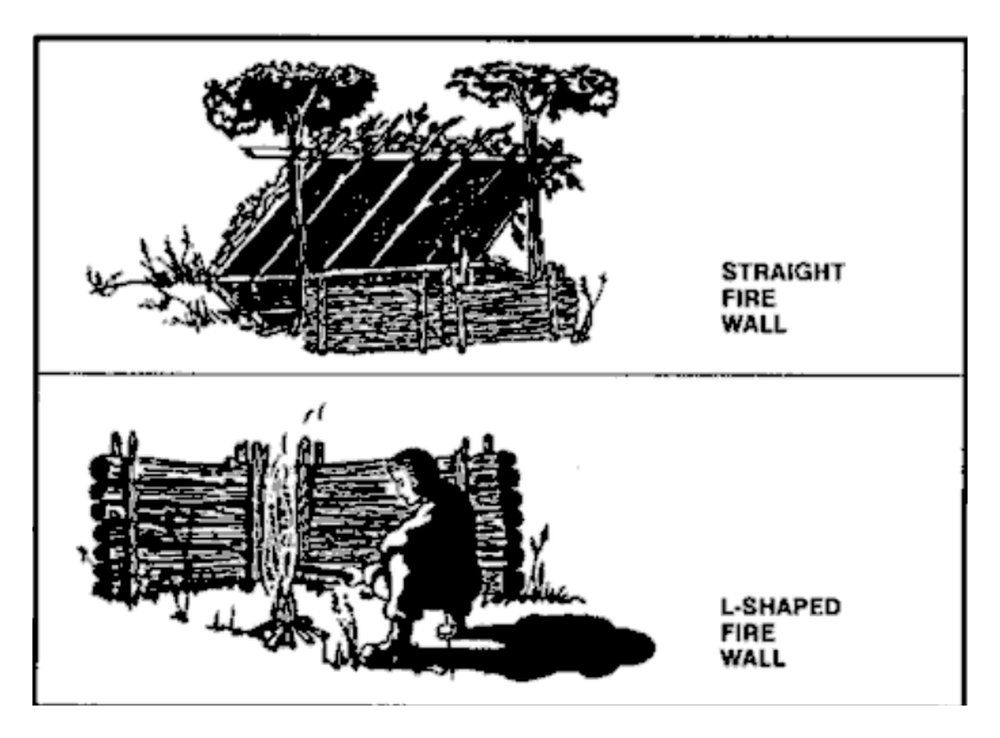
Straight and L-shaped fire walls Reflector wall for a lean-to: drive four stakes about 5 feet (1.5 meters) long into the ground. Stack green logs between them, one on top of another, in two rows. Green logs are freshly cut, living wood. They do not catch fire easily, which is why they work as a wall. The four tall stakes hold the logs in two stacked rows with a gap between them. Check that the wall stands on its own before you light the fire.
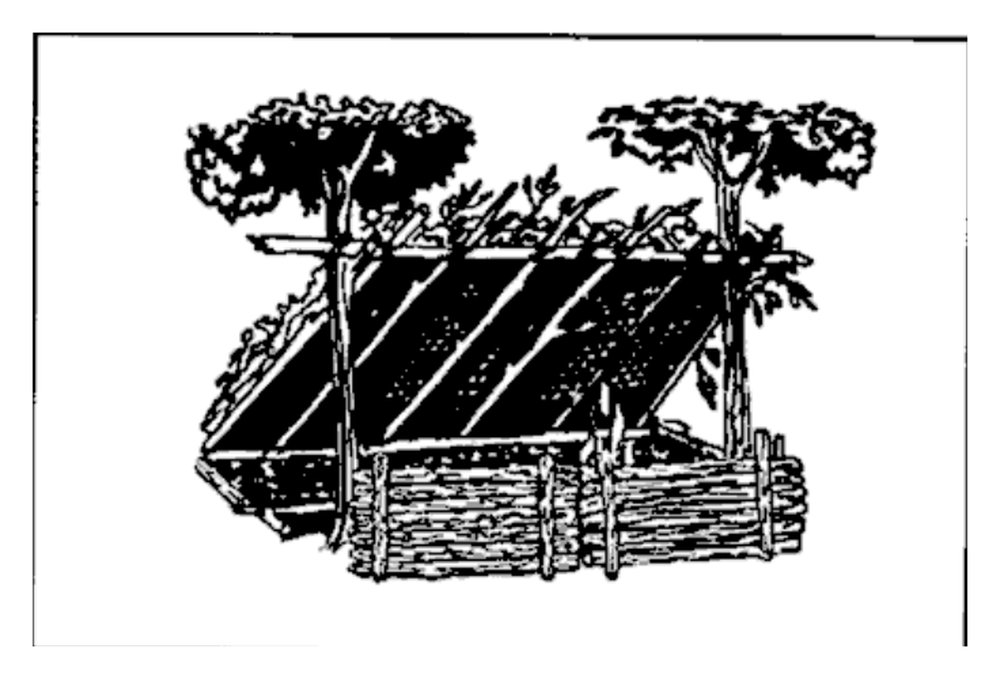
A lean-to with a fire reflector Fill the space between the two rows with dirt. That strengthens the wall and makes it reflect more heat. Bind the tops of the stakes together so the logs and dirt stay put. Dirt packed between the rows makes the wall heavier, stronger and better at throwing heat back. Tying the stake tops together keeps the rows from spreading apart as the logs dry and shift.
A drying rack costs little more: lay poles about 3/4 inch (2 centimeters) thick from the lean-to's horizontal support to the top of the reflector wall, and tie smaller sticks across them. Now you can dry clothes, meat or fish. With the wall up, a few poles from the lean-to's crossbar to the top of the wall make a rack in the warm air between them. Hang wet socks and clothes there to dry. Check them often so they do not scorch.
In deep snow, FM 31-70 heats a lean-to with a log fire: two, better three, dry hardwoodhardwood Wood from trees with broad leaves, like oak, maple and hickory. Burns long and makes good coals. logs about 1 foot (20 to 40 centimeters) thick and as long as the lean-to. Set two side by side on small green blocks so they sit above the snow for draft, and the third on top in the middle. Chip the surfaces that face each other, wedge small sticks between them for draft, and light it at several points so it spreads along the logs. It burns all night with little care. In deep snow a fire sinks as it melts the snow under it, so the logs sit up on small green blocks. The chipped, facing sides and small wedges between the logs let air in so they keep burning. Laid this way, the manual says, the fire burns all night with little care.
Keep the fire a safe distance from the shelter. Fires have burned underground and come up nearby. In a snow shelter, too much heat melts the insulatinginsulation Anything that traps still air and slows heat from leaving: dry leaves, pine needles, snow, wool, a puffy jacket. snow, and melting snow overhead can wet you, bury your gear or put the fire out. Sparks set a thatched roof alight, and a person drying clothes gets careless and scorches them. The manuals give no set distance, so watch and adjust. Close enough to feel the warmth, far enough that sparks do not land on the roof and heat does not melt a snow shelter. Fires have been known to burn underground and come up nearby, so never build one right against a shelter.
Inside an enclosed shelter, any open flame makes carbon monoxidecarbon monoxide A colorless, odorless gas from any open flame or stove in a closed space. It can kill without warning; the one visible sign is cherry red lips and inner eyelids., so ventilate and never sleep with it burning. A single candle is enough to warm a small enclosed shelter, and a fire the size of your hand gives considerable warmth and heats liquids. Carbon monoxide is a poison gas that comes from any flame and cannot be seen or smelled. In a closed shelter, keep a vent open and put out every flame before sleep. A small flame is often all you need inside: the manual says a single candle can warm a small enclosed shelter.
Bank the fire to keep the coals alive overnight, and be sure it is out before you leave camp. Banking a fire means piling ashes and coals together so they glow slowly overnight and are easy to bring back to life in the morning. When you leave, put it out cold: the MWTC handbook says drown it with water, stir the ashes, feel for hot spots, and start over if you find any.
Tips from survival instructors
- A reflector wall of stacked green logs behind the fire bounces heat into your shelter. Without it, most of the heat goes the wrong way.
- Keep the fire about a big step from the shelter. Close enough to feel, far enough that sparks do not catch the roof or bedding.
Common mistakes
- Building the fire too close to the shelter. The fix: keep it far enough that sparks and heat cannot reach the roof or walls.
- Using wet or porous rocks in a fire wall. The fix: use dry, solid rocks or green logs; the manual warns wet or porous rocks can explode.
- Skipping the cleared circle. The fix: scrape a circle at least 3 feet (1 meter) across down to bare soil.
- Building a fire on deep snow with no base. The fix: lay green logs or blocks under it so it does not sink.
- Getting careless drying clothes. The fix: hang them on a rack and check them often; the manual says people trying to get warm often burn or scorch their gear.
- Leaving camp with warm coals. The fix: drown, stir and feel until there are no hot spots.
Practice it safely
Practice only where fires are allowed, such as a campground fire ring or your own yard if local rules permit, with water nearby. Set up a tarp lean-to and use the ring as your fire, then sit in front and feel how much warmer your back is with a low wall of dry, solid rocks stacked behind the fire. Put it out cold before you leave.
Cutting green logs means cutting live trees, which most parks do not allow. To practice the wall itself, use fallen logs on land where the owner says yes, or build a small model with sticks and dirt on a table. Take everything apart when you are done and leave the place as you found it.
Quick check
What does the reflector wall behind the fire do?
- Hides the fire
- Bounces heat into the shelter and blocks the wind
- Makes the fire burn hotter
Show the answer
Bounces heat into the shelter and blocks the wind
Take the quiz and earn the badge
The app checks your answers, keeps your place in the Shelter, and works with no signal once saved.
Before you rely on thisA learning tool, not a replacement for training. In an emergency, call 911.
Sources
- US Army Survival Manual, pages 59 to 60 (fire reflector wall, drying rack), 82 to 84 (fire site, fire wall, rocks), 91, 197 and 202 (fire hazards in the cold)
- Army Cold Weather Manual, chapter 3 pages 13 to 14 (fire base, fire reflector, log fire)
- US Army Survival Manual, pages 59 to 60 (fire reflector wall, drying rack)
- US Army Survival Manual, pages 82 to 84 (fire site, 1 meter cleared circle, fire wall, wet or porous rocks)
- US Army Survival Manual, page 91 (bank the fire, be sure it is out before leaving camp)
- US Army Survival Manual, pages 197 and 202 (carbon monoxide, fire hazards in the cold, single candle, hand-sized fire)
- Army Cold Weather Manual, chapter 3 pages 10 to 11 and 13 to 14 (lean-to fire precautions, gather firewood for the night, green and frozen wood burns poorly, fire base, fire reflector, log fire)
- Army Cold-Weather Survival Handbook, page 61 (fire reflector of green logs, keep the fire from burning down the shelter)
- Marine Corps Winter Survival Handbook