Level ground, big enough to lie down on. Lie down on the spot before you build anything. If you roll, slide, or feel a root or rock in your back, move. The spot should also have the material you need close by, such as polespoles Dead, straight sticks about as thick as your wrist and 2 to 3 meters long. Dead standing wood is best: dry, and it snaps clean. and leavesdebris Dry leaves, pine needles, grass and ferns. Piled deep they trap still air, which is what keeps you warm. for a debris hutdebris hut A small shelter of sticks with a thick pile of leaves on top and inside. Your body heat warms the tiny space., so you do not waste energy hauling it.
Shelter · Shelter course
Pick a shelter spot
Why this matters
Where you build matters as much as what you build. A good roof in a bad spot can get flooded, buried by a falling limb, or sit in the coldest air in the valley. The manual gives two must-haves: the spot has the materials for the shelter you need, and it is big enough and level enough to lie down on comfortably.
The manual's short guide for picking a shelter spot is BLISS: Blend in, Low silhouettesilhouette The outline of something against what is behind it. A low silhouette means low to the ground and hard to pick out., Irregular shape, Small, and Secluded. For a lost hiker the most useful letters are Low and Small, because a low, small shelter holds your heat. Still pick a spot where you can signalsignal Anything in threes means help: three fires, three whistle blasts, three piles of rocks., so rescuers can find you.
What you need
- Nothing but your eyes and a few minutes of looking around.
- Helpful: a stick to poke the ground for wet spots, and enough daylight to see the trees above you.
Step by step
Look up: no dead limbs or dead trees that could fall on you. Dead trees and dead limbs fall without warning, often in wind or under snow. The manuals list falling rocks and "standing dead" trees as hazards to avoid. Look straight up and all around: broken limbs hung up in other trees, bare branches in a leafy season, and trees with peeling barkbark slabs Big sheets of bark peeled off a dead log. Laid like shingles, bottom row first, they shed rain. or leaning trunks are reasons to move.
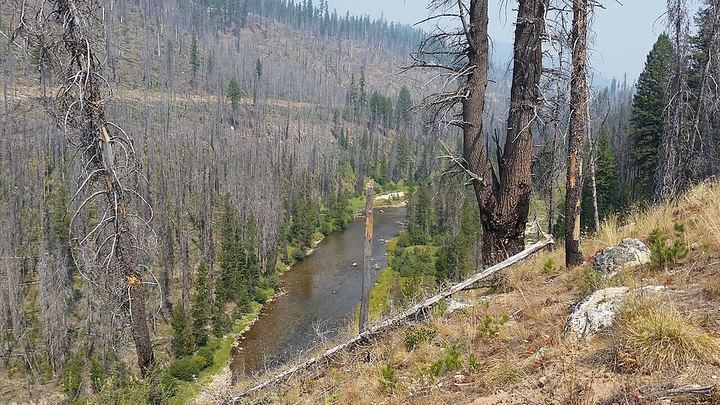
Dead standing trees (snags) can fall. Camp away Stay out of low ground and creek beds. Cold air and flood water collect there. Cold air is heavy and slides downhill at night, so ravines, narrow valleys and creek beds are colder than the ground around them. Thick, brushy low ground also has more insects, and the manuals warn about flash floods in ravines and dry riverbeds. A gentle rise is better than a bottom, but avoid an exposed hilltop where the wind hits hard.
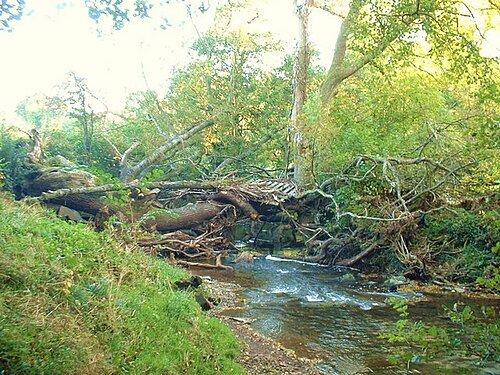
Flood debris in a creek bed: water rises here Stay above the high-water markhigh-water mark The line of debris, flattened grass or stained rock that shows how high the water rose in the last flood. Camp above it. near any stream or pond. The high-water mark is the highest line that a stream or pond reaches in a flood. You can often see it as a line of mud, sticks, trash or flattened grass on the bank. Build above it, because water can rise fast, even at night when you are asleep.
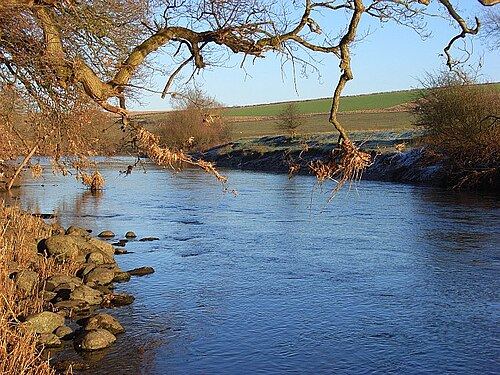
Debris stuck in branches marks the high-water line Keep it small. A small shelter holds your body heat. The manual says the most common error in making a shelter is making it too large. A shelter has to be big enough to protect you and small enough that your body heat can warm it. If you can roll over but not much more, it is about right for one person.
Tips from survival instructors
- Look up before you build. Dead trees and dead branches, sometimes called widowmakers, fall without warning, often in wind.
- Do not camp in the very bottom of a valley or hollow. Cold air sinks and pools there at night, so a spot a little higher up is warmer.
- Pick a spot close to your building materials and to water, but not right beside the water, so you do not waste energy hauling.
Common mistakes
- Building in a hollow because it feels out of the wind. The fix: low ground fills with cold air at night; choose a gentle rise instead.
- Forgetting to look up. The fix: check for dead limbs, dead trees and loose rocks before you put down a single stick.
- Camping right beside the creek. The fix: move above the high-water mark and out of the flood path.
- Building big. The fix: keep it only large enough to lie in; the manual calls a too-big shelter the most common error.
- Using a natural shelter without checking it. The fix: the manual says check caves, crevices and brush for ticks, stinging insects and animals first. If you find a snake, leave it alone and choose another spot; snakes are protected in many states.
Practice it safely
On a walk in a park or the woods, play "pick the spot." Every so often, stop and choose where you would build if you had to stay the night. Say out loud why: level, nothing dead overhead, out of the low ground, above the water line, material nearby. Ask a friend to pick too and compare.
You do not have to build anything to practice this, which makes it good for any park, even where cutting wood is not allowed. Stay on trails where rules ask you to, and leave the place as you found it.
Quick check
Which spot is best for a shelter?
- The bottom of a ravine, out of the wind
- Level ground on a gentle rise with no dead limbs overhead
- Right beside the creek
Show the answer
Level ground on a gentle rise with no dead limbs overhead
Take the quiz and earn the badge
The app checks your answers, keeps your place in the Shelter, and works with no signal once saved.
Before you rely on thisA learning tool, not a replacement for training. In an emergency, call 911.
Sources
- US Army Survival Manual, pages 48 to 49 and 61
- US Army Survival Manual, pages 48 to 49 (shelter site selection, too large is the most common error, BLISS, avoid flash flood areas and sites below the high water mark)
- US Army Survival Manual, page 61 (low ground collects cold air, insects, dead limbs, check natural shelters)
- Military Survival and Rescue Guide, pages 9 and 60 to 61 (BLISS, dead standing trees, drainages and dry riverbeds, level enough to lie down)
- Marine Corps Winter Survival Handbook, pages 04-1 to 04-3 (standing dead trees, avoid exposed hilltops, valley floors and moist ground; low silhouette and small area keep heat)