Food comes last. Learn traps only after shelter, water and signals. Food takes a lot of time and energy and often brings nothing back, while cold or thirst can hurt you much sooner. The survival manual says some situations call for shelter before both food and water.
Trapping and fishing · Trapping and catching food course
Read animal sign
Why this matters
Reading animal sign is the part of trapping you can learn and practice anywhere, and it is legal everywhere. The survival manual says there is no trap that works for every animal, and a perfect trap catches nothing if it is placed in the wrong spot. You first have to know which animals live there and where they go.
The same skill helps in other ways. Animal trails can lead to water, and knowing what has been near your camp tells you what to watch for. This lesson teaches the looking, not the trapping. In many states, deadfallsdeadfall A trap that drops a heavy weight, like a log or rock, when an animal touches the trigger. and string snaressnare A trap made of a loop of wire or cord that tightens around an animal that walks or pokes its head through. are illegal, and rabbits and squirrels are hunting-only.
What you need
- Nothing but your eyes and patience.
- A stick for poking at droppingsscat Animal droppings. Fresh, moist scat means the animal used this spot recently. Never touch it with bare hands., never your fingers.
- A phone or notebook to photograph or sketch tracks, if you like.
- Soft ground helps: mud after rain, sand by a creek or fresh snow.
Step by step
Look for runs and trailsgame trail A narrow path worn through grass or brush by animals using it over and over. A trap goes on a trail an animal already uses.: narrow paths worn through grass or brush. A trail is like a highway: wide and clear, used by several kinds of animals, linking feeding, sleeping and watering places. A run is like a side street: smaller, fainter, and used by one kind of animal. Look for grass bent flat in a narrow line, or a low tunnel through brush.
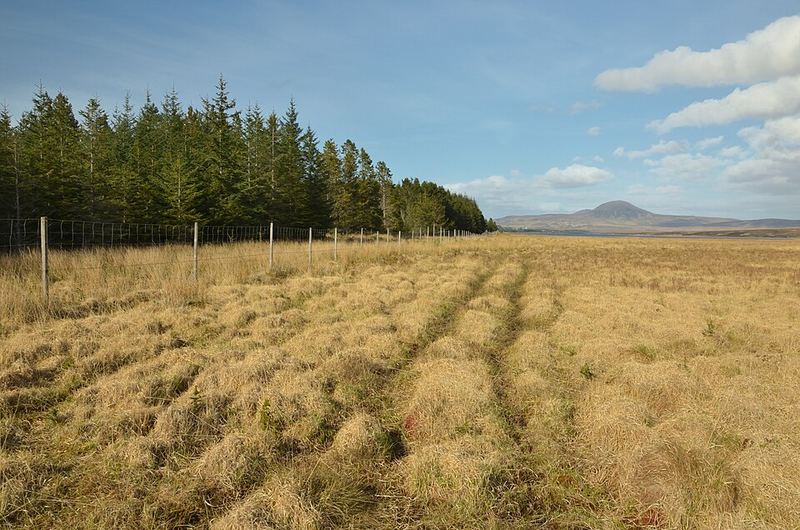
Narrow worn paths through grass are animal runs Look for tracks in mud, sand or snow along those paths. Count the toes. The winter survival handbook says the cat family shows 4 toe pads and no claw marks, the dog family 4 toe pads with claw marks, rabbits 4 toes with very big hind feet, rodents 5 toes behind and 4 in front, and raccoons, opossums and bears 5 toes like a baby's handprint. Early morning and late afternoon are best, when low sun casts shadows in the tracks.
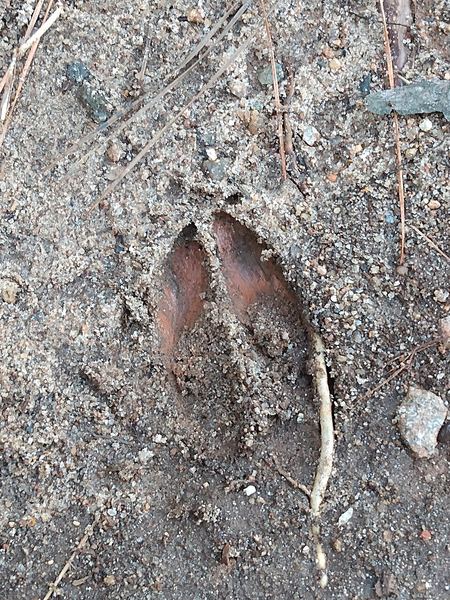
Deer track: two pointed halves, like a split heart 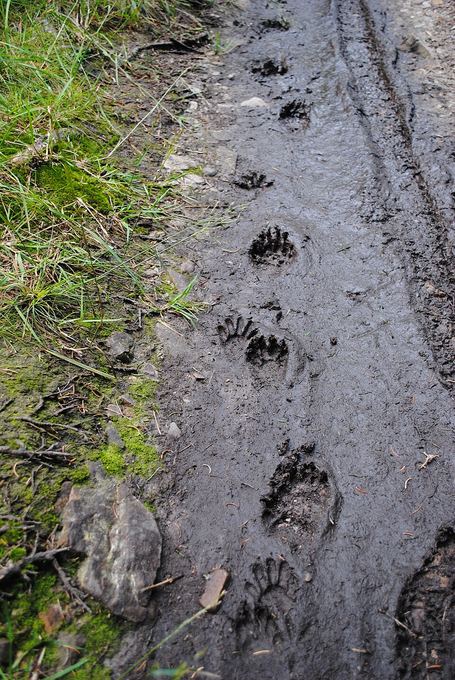
Raccoon tracks in mud: small hand-like prints Look for droppings. Fresh droppings mean an animal uses the spot now. The handbook says droppings dry from the inside first, so a wet outside does not prove they are fresh; only the inside tells you. Break them open with a stick, never your hands.
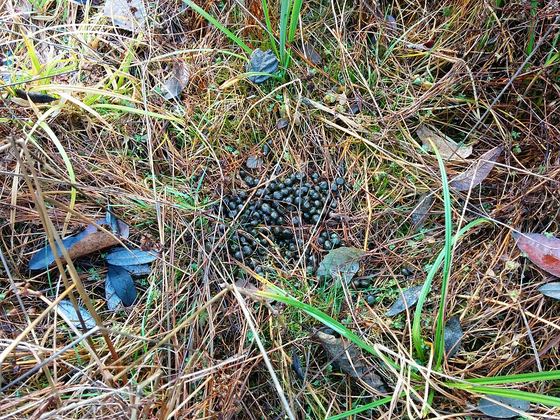
Deer droppings: piles of small dark pellets Look for chewed or rubbed plants and holes or dens at the base of trees. Other sign includes chewed barkbark slabs Big sheets of bark peeled off a dead log. Laid like shingles, bottom row first, they shed rain. or twigs, rubbed spots where an animal squeezes under a log, claw scratches at the base of a tree, flipped leavesdebris Dry leaves, pine needles, grass and ferns. Piled deep they trap still air, which is what keeps you warm. showing their darker underside, and stones knocked out of place. Dens and beds turn up in hollow logs, rock piles, brush piles and thick grass.
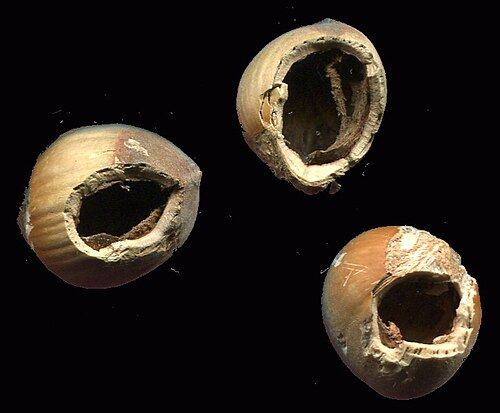
Gnawed nut shells show squirrels feed here 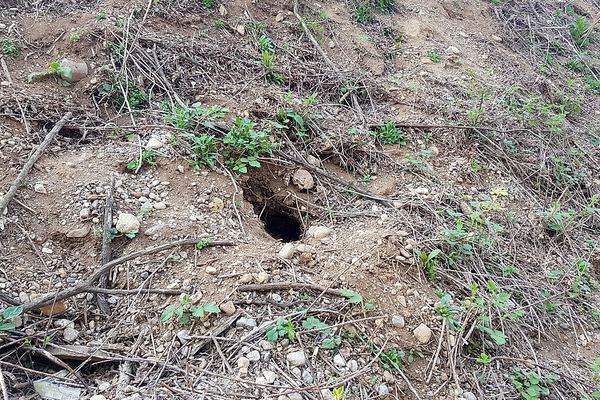
A burrow hole with fresh dirt means a den is used Converging trails often lead to water. Plant-eating animals like deer are usually never far from water and drink at dawn and dusk, so where their trails come together, water is often near. Meat-eaters are not a good guide, because they get water from what they eat.
Never touch droppings with bare hands. They can carry disease. The winter survival handbook says raccoon roundworm can stay in droppings for at least 30 days, and that deer mouse droppings can carry hantavirushantavirus A rare but deadly lung illness spread by deer mouse droppings. Breathing dust from dried droppings is how people catch it., which spreads when the dried droppings get stirred into the air you breathe. Use a stick, do not kick up old droppings, and wash your hands afterward.
Tips from survival instructors
- Look along edges where two kinds of land meet, like a forest beside a field or a stream bank. Animals travel and feed there.
- Fresh tracks have sharp edges and crisp details. Old tracks look rounded, with leaves or dirt fallen into them.
Common mistakes
- Walking right down the animal trail. You leave your scent and tracks on it; walk beside it and look from the edge.
- Looking at midday. Flat light hides tracks; go out early or late, with the track between you and the sun.
- Judging droppings by the outside. Check the inside, with a stick.
- Touching droppings, or sweeping out a shed or shelter full of mouse droppings. Do not stir them up, and do not use shelters where rodents have been living.
- Rushing ahead. The handbook says not to move past the last sign until you have found the next one.
Practice it safely
This is the most useful trapping skill to practice, and you can do it in a yard, a park or a nature preserve. After a rain or a snowfall, walk slowly along the edge of a field, a creek bank or a woods edge. Photograph each track, count the toes, look for claw marks, and guess the animal family. Look for where several trails meet and see if water is nearby.
Stay on park trails where the rules ask you to, leave dens and nests alone, and leave everything as you found it. Never build or set a trap.
Quick check
Where does a trap go?
- Anywhere in the woods
- On a trail or run animals already use
- Next to your shelter
Show the answer
On a trail or run animals already use
Take the quiz and earn the badge
The app checks your answers, keeps your place in the Trapping and catching food, and works with no signal once saved.
Before you rely on thisA learning tool, not a replacement for training. In an emergency, call 911. Do not eat any plant, berry or mushroom here. This app never tells you a wild food is safe.
Sources
- US Army Survival Manual, pages 99 and 184
- US Army Survival Manual, pages 24 (wash your hands), 92 (food, water and shelter priorities), 99 (where to look for sign, runs and trails) and 184 (animals as signs of water)
- Marine Corps Winter Survival Handbook, pages 68 to 75 (trails and runs, beds, rubs, scratches, gnawing, scat, sign, track families, aging tracks and scat, tracking) and 96 to 98 (hantavirus, raccoon and fox roundworm in scat)