Pick how you count and stick with it. The Army counts every natural step, about 30 inches. Many hikers count only when the left foot lands, which halves the numbers. This lesson counts every step, like the Army.
Finding your way · Finding your way course
Pace count: know how far you walked
Map readers keep track of distance by counting steps. It sounds simple, and it is: once you know how many of your steps make 100 meters, you can tell how far you have gone in fog, in the dark, or in woods with no landmarks. Combined with a compass bearingbearing A direction to travel, measured as an angle from north, like 90 degrees for east. it is called dead reckoningdead reckoning Finding your way with only a direction and a distance: walk a set bearing and count your steps, leg by leg..
Why this matters
A map tells you the trailgame trail A narrow path worn through grass or brush by animals using it over and over. A trap goes on a trail an animal already uses. junction is 800 meters away, but in the woods it is hard to tell how far you have gone. Counting pacespace count How many of your steps it takes to cover 100 meters. Counting paces tells you how far you have walked. turns a guess into a number.
It is how soldiers and orienteers find small things in big forests, and it takes no gear at all.
What you need
- Something to keep count: a cord with knots, pebbles, or pace beads.
20 minutes on a track or field to learn your count.
Step by step
Find your number: walk a measured 100 meters (about 110 yards) at a normal pace, like on a school track or a football field plus 10 yards, and count. Do it three times and average. Walk it on ground like the ground you will travel; a count from a flat track is off on hills.
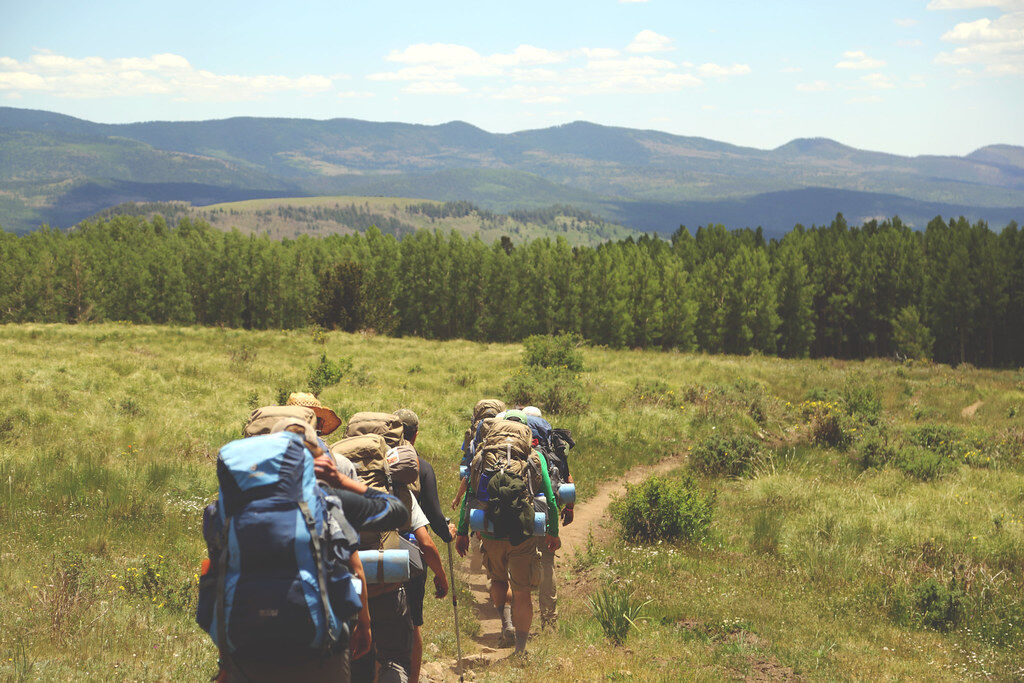
Count your steps on ground like the ground you will walk Keep count with something you can feel: tie knots in a cord, move a pebble from one pocket to another, or slide a bead every 100 meters.
Adjust for the ground. You take more steps uphill, in deep snow, in mud, in thick brush and at night, and fewer going downhill. Walk test stretches on slopes to learn how much your count changes.
Dead reckoning: from a known point, walk a set bearing and count your paces. Mark the distance on your map or write it down. Each leg of the trip is a bearing plus a distance.
Check against the land. When you reach a stream, a road or a hilltop you expected, compare your count to the map and correct it.
Know your daylight. Hold your arm straight out, fingers together and thumb tucked, and count fingers between the sun and the horizon. Each finger is roughly 15 minutes of daylight left, each hand about an hour. Start making camp with at least two hours of light left, more in winter.
Tips from survival instructors
- Your steps get shorter when you are tired, carrying a heavy pack, or walking in snow, so your count goes up.
- Make a set of pace beads from a cord and 13 beads: 9 below a knot for each 100 meters and 4 above for each kilometer.
Common mistakes
- Trying to keep the count in your head. The fix: use knots, pebbles or beads.
- Using a flat-ground count on hills. The fix: learn your count on slopes too.
- Never checking against landmarks. The fix: correct your count at every stream, trail or hill.
Practice it safely
Walk 100 meters on a track three times and average your count. Then walk a trail with known distances, like a park loop, and see how close your count comes.
Quick check
What is dead reckoning?
- Guessing
- Walking a known bearing while counting the distance
- Following a river
Show the answer
Walking a known bearing while counting the distance
Take the quiz and earn the badge
The app checks your answers, keeps your place in the Finding your way, and works with no signal once saved.
Before you rely on thisA learning tool, not a replacement for training. In an emergency, call 911.
Sources
Photo credits
Photo: Image Catalog, CC0 1.0, source