Learn two constellations: the Big DipperBig Dipper Seven bright stars shaped like a ladle or a pot with a handle. Its two outer bowl stars point to the North Star. (also called Ursa Major or the Plow) and CassiopeiaCassiopeia Five stars in a W (or M) shape on the opposite side of the North Star from the Big Dipper.. Neither ever sets, so on a clear night both are always somewhere in the sky. A constellation is a group of stars that makes a picture or shape. These two never dip below the horizon in the northern sky, so one or both will always be up on a clear night.
Finding your way · Finding your way course
Find the North Star
Two constellationsconstellation A group of stars that makes a shape or picture, like the Big Dipper. never set in the northern sky, and between them they point to PolarisPolaris The North Star. It stays almost still over true north while the other stars turn around it., the North Star. Stand facing it and you face true northtrue north The direction of the North Pole. The North Star sits almost exactly over it.. The manual also gives a quick east-west check from the moon.
Why this matters
At night the sun methods do not work, but on a clear night the North Star does. It sits almost straight above the North Polepoles Dead, straight sticks about as thick as your wrist and 2 to 3 meters long. Dead standing wood is best: dry, and it snaps clean., so it stays in nearly the same place while the rest of the sky turns around it. Facing it means facing north.
The North Star is not the brightest star, so people often pick the wrong one. Learning the two star patterns that point to it, and using both together, is what makes the method reliable.
What you need
- Nothing but your eyes and a clear night sky.
- A stick or two to mark the direction on the ground if you want to keep it for the morning.
- For an improvised compass: a needle, a thin razor blade or other slim piece of iron or steel, silk or your own hair, and a thread or a small chip of wood and some water.
A few minutes on a clear night once you know the shapes.
Step by step
Both point to Polaris, the North Star, which is the end of the Little Dipper's handle. The Little Dipper can be confused with the Big Dipper, so use the Big Dipper and Cassiopeia together to be sure. The Little Dipper is smaller and dimmer, and its shape looks a lot like the Big Dipper, which is why people mix them up. When both the Big Dipper and Cassiopeia point to the same star, you have the right one.
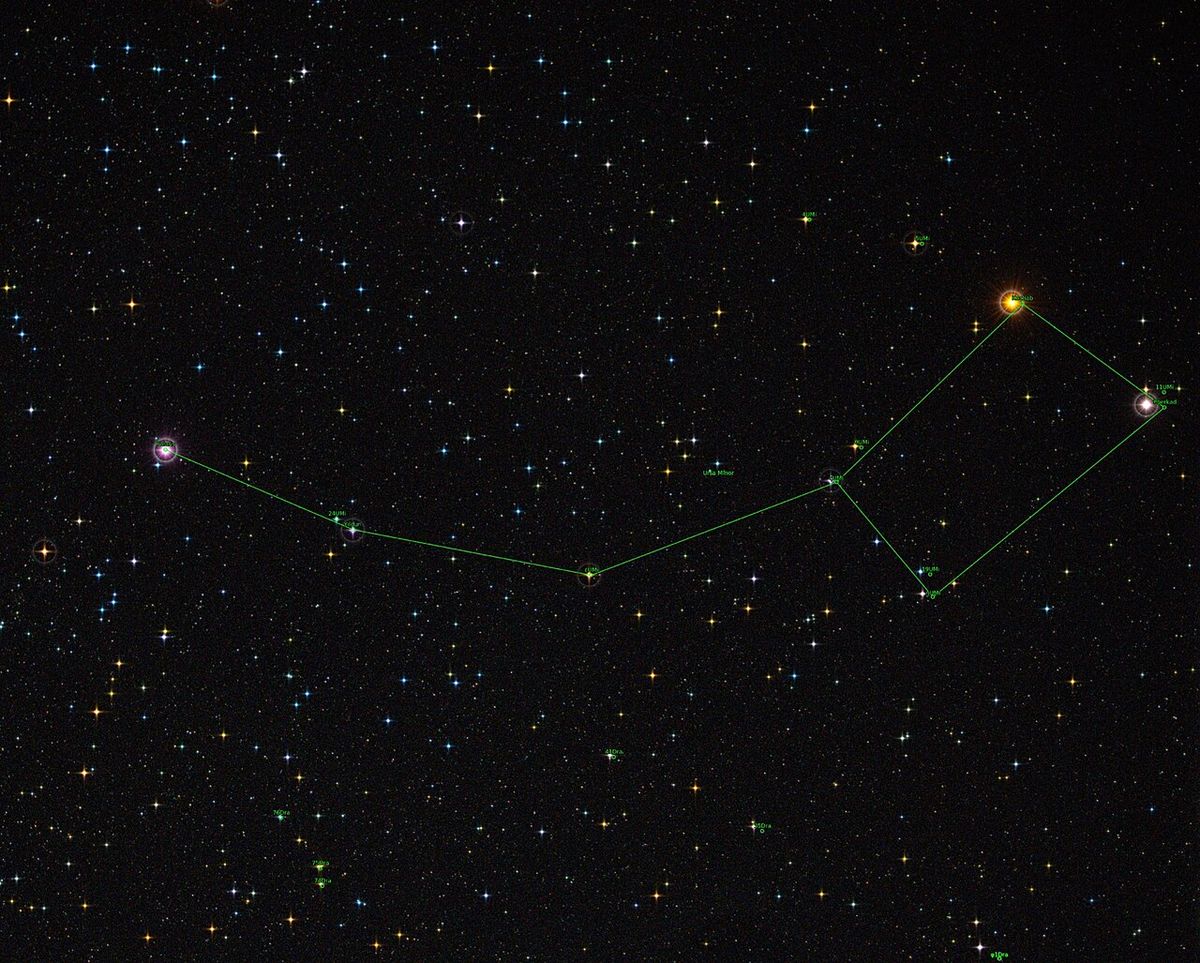
The Little Dipper: the North Star is the end of its handle The two are always directly opposite each other, and they rotate counterclockwise around Polaris with Polaris at the center. Through the night the whole sky turns slowly around the North Star like a wheel around its hub. So the Big Dipper may look upside down or on its side at different times. That is normal; the pointer starspointer stars The two stars on the outer edge of the Big Dipper's bowl. A line through them, extended about five times their spacing, hits the North Star. still point the same way.
The Big Dipper is seven stars in the shape of a ladle. The two stars that form the outer lip of the bowl are the pointer stars. Draw a line from the outer bottom star through the outer top star and extend it about five times the distance between them. The North Star is on that line. A ladle is a big spoon with a long handle. The two stars on the side of the bowl farthest from the handle are the pointers. Measure the gap between them with your fingers held at arm's length, then count out about five of those gaps along the same line.
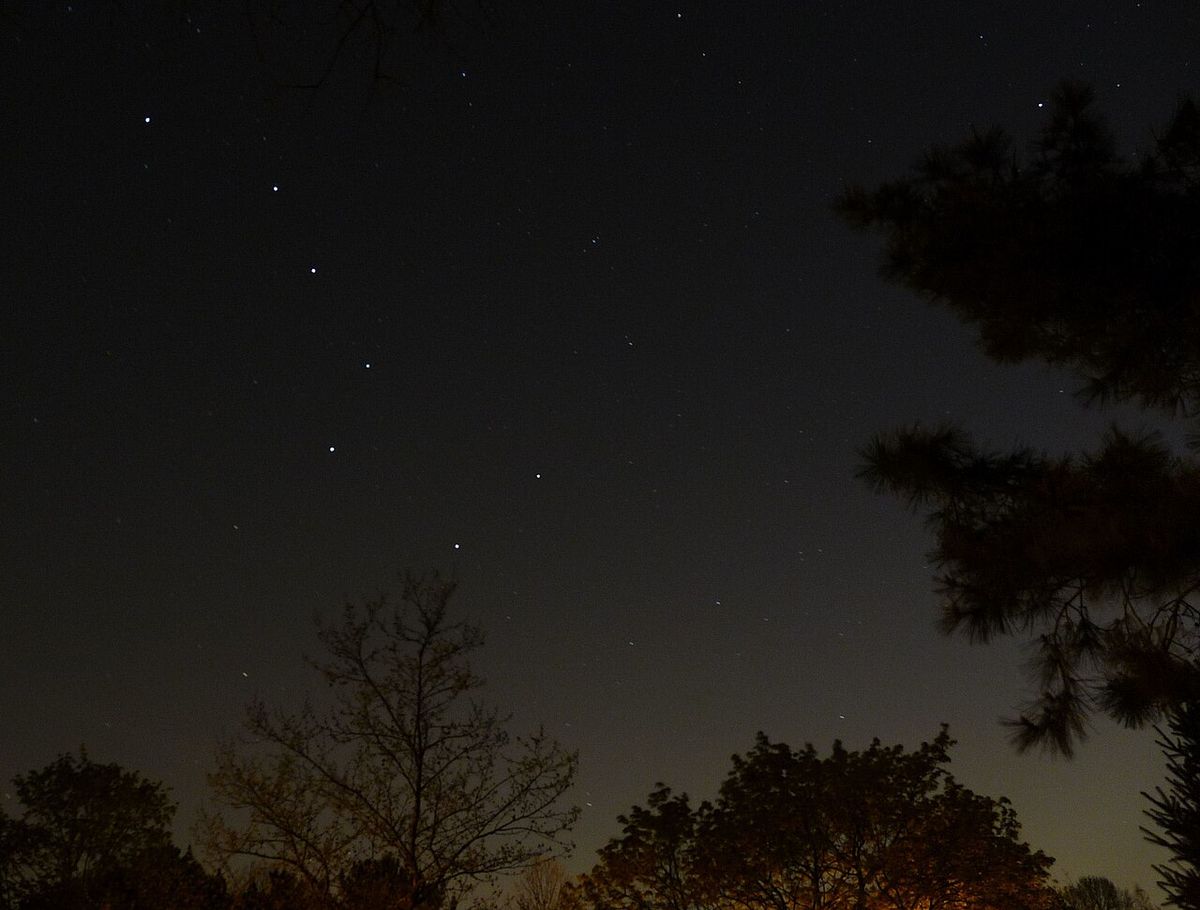
The Big Dipper, with the North Star above the lip of its bowl Cassiopeia is five stars in a W on its side. The North Star is straight out from the center star of the W. The W may look like an M or a 3 depending on the time of night. Find its middle star and look straight out from it. The North Star should be the same star the Big Dipper pointed to.
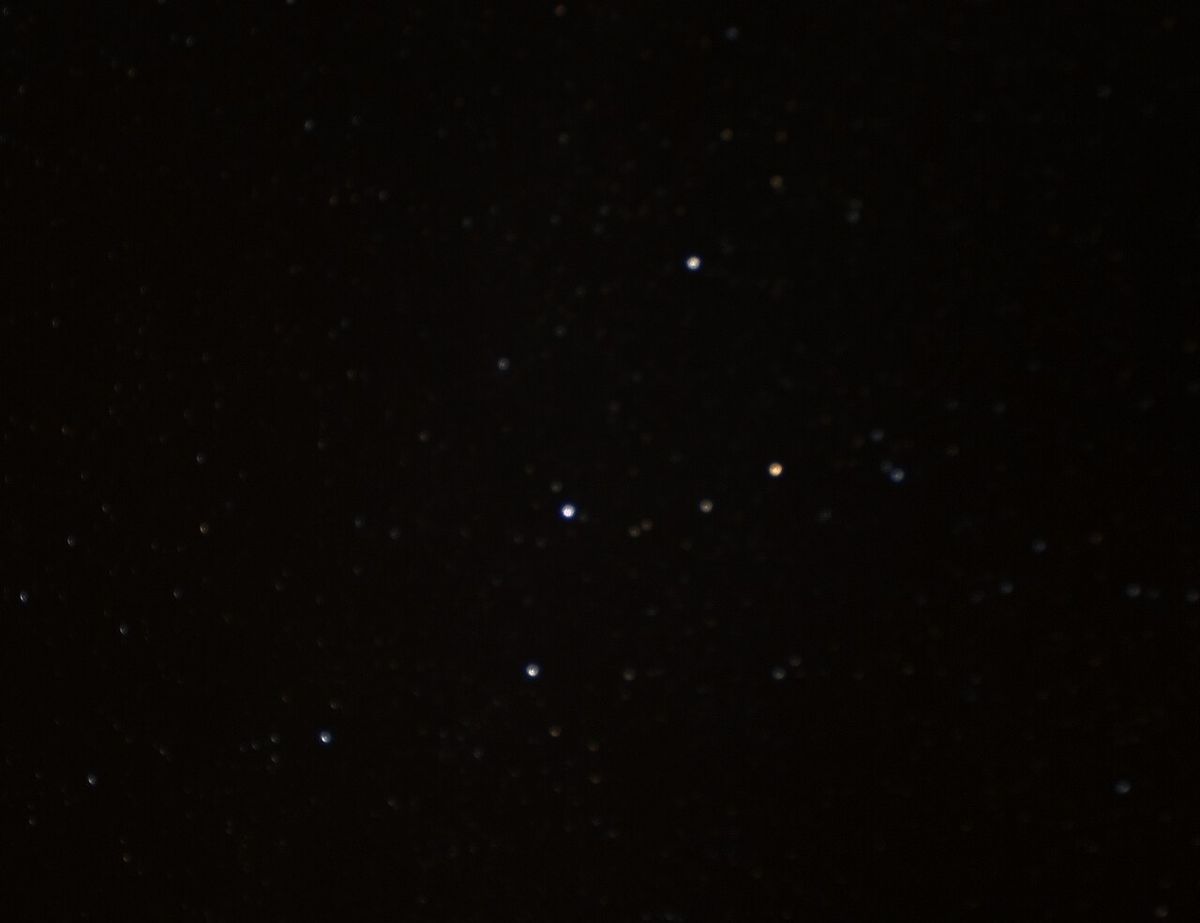
Cassiopeia: five stars in a W on its side From the North Star, drop an imaginary line straight down to the horizon. That point is true north. Pick a landmark there to steer by. The point on the horizon right below the North Star is true north. A star is hard to follow while you walk, so pick a tree, rock or hilltop in that direction and steer toward it.
The moon gives a rough east-west line. If it rises before the sun has set, its lit side faces west. If it rises after midnight, its lit side faces east. The moon's bright side is the side facing the sun. This gives only a rough east-west guide, so use it as a check, not as your only answer.
The manual's tip for fixing a night bearingbearing A direction to travel, measured as an angle from north, like 90 degrees for east. for daylight (given for the Southern Cross) works with the North Star too: if you are staying put, drive stakes in the ground at night that point the way, and use them in the morning. If you plan to stay in one place, two sticks pushed into the ground in a line pointing at the North Star save that direction. In the morning, the line is still there to show you north.
Improvised compass: magnetizemagnetize Make a piece of steel into a weak magnet, for example by stroking a needle the same way many times with a magnet or silk. a needle, a razor blade or any slim piece of iron or steel by stroking it in one direction only on silk, through your hair, or with a magnet. Hang it from a non-metal thread or float it on a chip of wood in water and it settles on a north-south line. Magnetize means to turn the metal into a weak magnet. Stroke in one direction only, lifting the metal away at the end of each stroke. The needle settles on a line from north to south but does not show which end is which, so check it once against the sun or the North Star. A magnet points to magnetic northmagnetic north The direction a compass needle points. It is near the North Pole but not exactly on it., which can be a little off from true north.
Star and sun methods give a general direction. The more you know about the terrainterrain The shape and kind of the land: hills, valleys, rock, swamp, forest. and its landmarks, the truer your heading will be. Your heading is the direction you are walking. Star methods give a general direction. Knowing landmarks like rivers, ridges and roads helps you stay on track and catch mistakes.
Tips from survival instructors
- The North Star is not the brightest star. Find it with the Big Dipper's pointer stars instead of hunting for a bright one.
- Mark the direction at night with two sticks lined up on the North Star. In the morning they still point north.
Common mistakes
- Using the Little Dipper and mistaking it for the Big Dipper. Fix: use the Big Dipper and Cassiopeia together; both must point to the same star.
- Using the wrong two stars of the Big Dipper as pointers. Fix: use the two stars on the outer lip of the bowl, from the bottom one through the top one.
- Not going far enough along the pointer line. Fix: about five times the gap between the two pointers.
- Trying to walk while staring at a star. Fix: drop a line to the horizon, pick a landmark below the North Star and steer by that.
- Stroking the needle back and forth. Fix: stroke in one direction only.
Practice it safely
On a clear night in your yard or a dark park, find the Big Dipper and Cassiopeia, follow both to the North Star, and push two sticks into the ground to point at it. In the morning, check your sticks with a phone compass or the shadow-stick method. Try again a few hours later to watch the Big Dipper turn around the North Star.
At a table, make an improvised compass: stroke a sewing needle in one direction on a silk scarf or through your hair, lay it on a small leaf or chip of wood floating in a bowl of water, and see which way it settles. Compare it with a real compass. Handle the needle carefully, and keep it away from small children.
Quick check
Which two constellations never set in the northern sky?
- Orion and the Big Dipper
- The Big Dipper and Cassiopeia
- The Southern Cross and the Little Dipper
Show the answer
The Big Dipper and Cassiopeia
Take the quiz and earn the badge
The app checks your answers, keeps your place in the Finding your way, and works with no signal once saved.
Before you rely on thisA learning tool, not a replacement for training. In an emergency, call 911.
Sources
- US Army Survival Manual, pages 252 and 255 to 258 (the moon, the northern sky, stakes to mark a bearing, improvised compasses)
- US Army Survival Manual, page 252 (sun and star methods give only a general direction; know the terrain)
- US Army Survival Manual, pages 255 to 257 (the moon, the northern sky, Big Dipper pointers, Cassiopeia, true north, stakes to fix a bearing, improvised compasses)
- Military Survival and Rescue Guide, pages 18 and 19 (North Star for a true north-south line, magnetic variation)