Pick a spot with firm soil, away from tree roots, which can catch fire and smoldersmolders Burns slowly with smoke and a glow but no flame yet. underground. Check that fires are allowed.
Fire · Fire course
Dakota fire pit and a fire that lasts all night
A Dakota fire holeDakota fire hole A fire built in a hole in the ground, with a second tunnel feeding it air. Hard to see, and it burns hot on little wood. is a fire built underground with an air tunnel. It burns hot on very little wood, is hard to see, stays lit in wind, and holds a pot over the flames. The second skill here is keeping coals alive overnight so you do not have to start from scratch in the morning.
Why this matters
A Dakota fire hole burns hot on very little wood and stays lit in wind, which makes it good for cooking and for windy, open places.
Banking a fire overnight saves you from starting a new fire every morning, when your hands are cold and your tindertinder The driest, finest material you have, which catches a spark or small flame: shredded inner bark, dry grass, birch bark curls, cattail fluff. may be damp.
What you need
- A small shovel, trowel or digging stick, and dry hardwoodhardwood Wood from trees with broad leaves, like oak, maple and hickory. Burns long and makes good coals.. Water to put it out.
About 20 minutes to dig; a few minutes to bank a fire.
Step by step
Dig the fire hole about a foot deep and about as wide as a dinner plate, a little wider at the bottom.
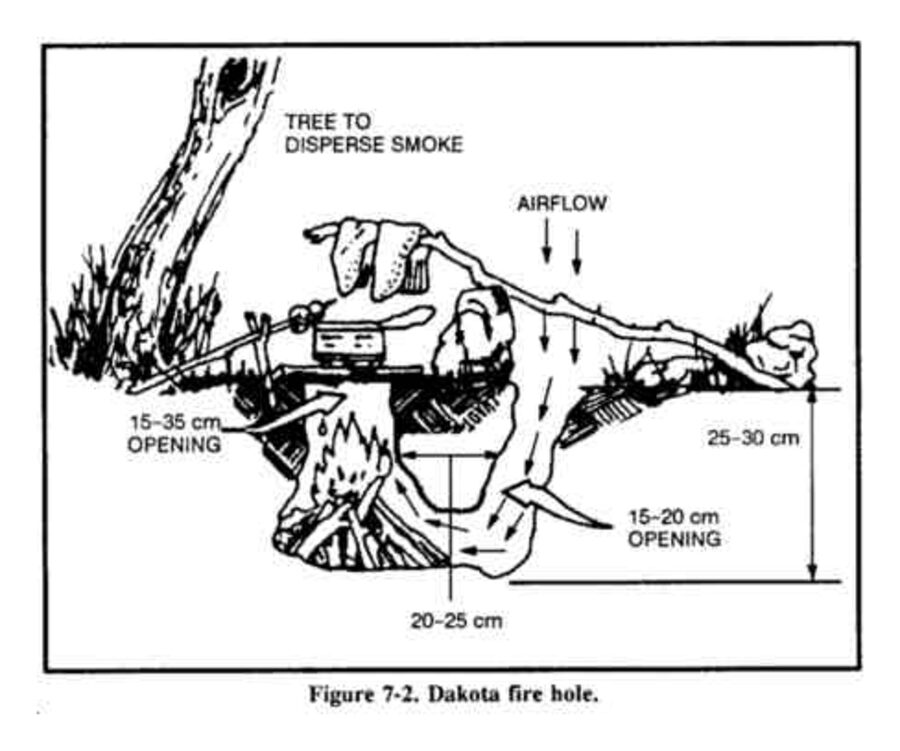
The fire hole and the air tunnel that feeds it Find which way the wind blows. About a foot upwind, dig a second, smaller hole at an angle so it meets the bottom of the first. That is the air tunnel.
Build a small fire in the bottom of the main hole and feed it short, thin sticks. Wind blowing down the tunnel feeds air to the fire, so it burns hot with little smoke.
Set a pot across the top on two green sticksgreen wood Wood cut from a living tree, still full of sap. It will not burn easily, which is why it makes the base under a fire on snow and the reflector wall behind one. to cook. When done, fill the holes with water and dirt and stir until cold.
Keeping a fire overnight: before bed, build up a bed of glowing coals from hardwood. Add a few thick hardwood logs, not small sticks.
Bank the fire: rake the coals into a pile and cover them with a layer of ashes, or lay big logs close together over them. This slows the burn so coals last until morning.
In the morning, scrape off the ash, add tinder and small sticks to the glowing coals, and blow gently. Never leave a fire unwatched while you are awake and away from camp.
Tips from survival instructors
- Line the edges with flat stones and the pot sits steady over the hole.
- Hardwoods like oak, maple and hickory make the long-lasting coals you need for an overnight fire.
Common mistakes
- Digging near tree roots. The fix: pick bare ground away from trees.
- Putting the air tunnel downwind. The fix: it goes on the side the wind comes from.
- Banking with too little coal. The fix: build a deep bed of hardwood coals first.
- Leaving a hole half filled. The fix: drown it, stir it and fill it until it is cold.
Practice it safely
Where fires are allowed, dig a Dakota hole in a backyard fire spot or campsite and boilrolling boil Big bubbles breaking the whole surface, not just a few at the edge. One full minute of this kills the germs that make you sick. a pot of water on it. Note how much wood it took compared with an open fire.
Quick check
Why does a Dakota fire hole burn hot on little wood?
- Magic
- The tunnel feeds it a steady stream of air
- Because it is deep
Show the answer
The tunnel feeds it a steady stream of air
Take the quiz and earn the badge
The app checks your answers, keeps your place in the Fire, and works with no signal once saved.
Before you rely on thisA learning tool, not a replacement for training. In an emergency, call 911.
Sources
Photo credits
Photo: US Army, FM 21-76 Survival (1992), Public Domain, source