Signs of a break: pain and tenderness at one spot, swelling, bruising, a bend where there should not be one, not being able to use it, or a grating feel. If you are not sure, treat it as broken.
First aid · First aid course
Splint a broken bone
A splintsplint A stiff support, like sticks or rolled-up magazines, tied along a hurt arm or leg so it cannot move. stops a broken bone from moving. That eases pain, stops the sharp ends from cutting more tissue, and makes it possible to move the person. You can build one from sticks, a rolled-up magazine, a sleeping pad or even the person's own body.
Why this matters
A broken arm or leg far from help can turn into a long, painful trip. A good splint lets the person move with less pain and less damage.
Splinting is mostly common sense, and nearly anything stiff can become a splint.
What you need
- Something stiff: straight sticks, a rolled magazine or newspaper, a sleeping pad or a trekking polepoles Dead, straight sticks about as thick as your wrist and 2 to 3 meters long. Dead standing wood is best: dry, and it snaps clean..
- Padding (clothing), and strips of cloth, belts or tape to tie it.
10 to 15 minutes.
Step by step
If bone sticks through the skin (an open fracturefracture A broken bone. A closed fracture stays under the skin; an open one pokes through.), cover the wound with a clean dressing first and control bleeding. Do not push the bone back in.
Check below the injury before splinting: the pulsepulse The beat of the heart you can feel in the wrist or neck. Count beats for 15 seconds and multiply by 4 for beats per minute., skin color and warmth of the hand or foot, and whether the person can feel your touch. Write down what you find.
Splint it in the position you found it. Do not try to straighten it unless you have been trained. Pad the splint well with cloth, especially at bony spots.
Make the splint long enough to hold the joint above and the joint below the break still. For a forearm, that means from the elbow past the wrist.
Tie it on in at least two places above and two below the break, with knots on the splint, not on the injury. Tight enough to hold, loose enough to slide a finger under.
Check the hand or foot again right after splinting and often after that. Cold, pale, blue, numb or tingling means the ties are too tight; loosen them.
Support an arm in a slingsling A throwing tool: a pouch with two cords. Swing it and let go of one cord to fling a stone. from a triangle of cloth or a buttoned jacket. Raise a splinted leg a little, keep the person warm, and watch for shock.
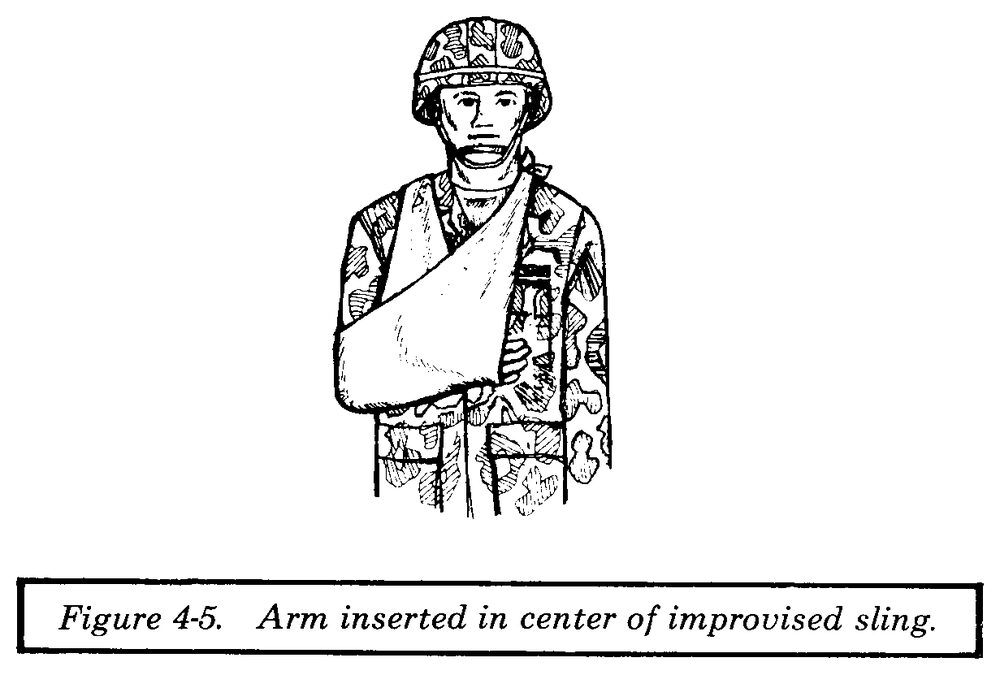
An arm resting in a sling
Tips from survival instructors
- Pad all the hollow spots between the splint and the limb so it cannot shift.
- A broken finger can be taped to the finger next to it, and a hurt leg to the good leg, when you have nothing else.
Common mistakes
- Splinting too short. The fix: reach past the joints above and below.
- Tying too tight. The fix: check fingers or toes for color, warmth and feeling.
- Tying knots over the break. The fix: tie on the splint, away from the injury.
- Moving the person before splinting. The fix: splint first, then move.
Practice it safely
With a friend, splint a pretend broken forearm using a magazine and a scarf, then a pretend lower leg using two sticks and a jacket. Time yourself, then check the fingers or toes like you would for real.
Quick check
Bone is showing through the skin. Push it back in?
- Yes
- No; cover the wound, control bleeding, splint as found
- Only if it is small
Show the answer
No; cover the wound, control bleeding, splint as found
Take the quiz and earn the badge
The app checks your answers, keeps your place in the First aid, and works with no signal once saved.
Before you rely on thisA learning tool, not a replacement for training. In an emergency, call 911.
Sources
Photo credits
Photo: US Army, FM 21-11 First Aid for Soldiers (1988), Public Domain, source