Poisonous mushroom
Destroying angel: the all-white mushroom that kills
Destroying angels are pure white Amanita mushrooms that grow in woods across the US in summer and fall. They carry the same liver-destroying poison as the death cap, and their clean white look fools people into thinking they are a grocery-store mushroom.
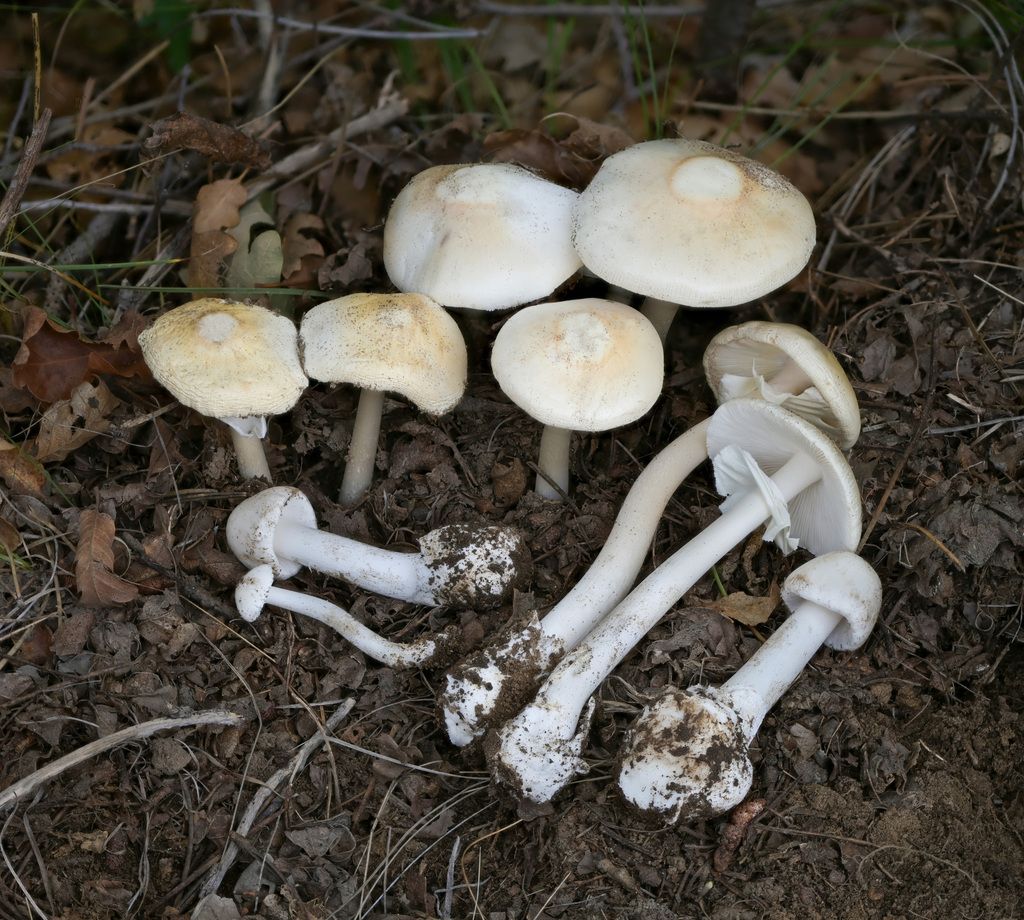
How to tell it
- Every part is white: cap, gills, stem and ring.
- Smooth cap 2 to 4 inches across, egg-shaped when young and flattening with age.
- Gills stay white and do not turn pink or brown.
- A skirt-like ring on the stem, though it can tear away.
- A sac-like cup at the base of the stem, usually below the leaf litter.
Where you find it
Mixed woods with oak, beech, birch and pine, on the ground, from midsummer into fall. The eastern destroying angel is common east of the Rockies; western species grow in California and the Pacific Northwest.
Scientific name: Amanita bisporigera and relatives
Look-alikes
Their gills turn pink and then chocolate brown, and they have no cup at the base. Young buttons and young destroying angels can still look alike.
Slice from top to bottom. A puffball is solid white all the way through; a young destroying angel shows a cap and stem forming inside.
Why it is dangerous
One mushroom can be enough to kill an adult. Like the death cap, it causes hours-delayed vomiting and diarrhea, a false recovery, and then liver and kidney failure. The survival manual says do not eat mushrooms in a survival situation, because only a certain identification tells safe from deadly.
What to do
- Call the Poison Help line or go to an emergency room right away if anyone ate a white wild mushroom. Do not wait.
- Save any leftovers, and dig up a matching mushroom with its base, for identification.
- Teach children never to put a wild mushroom in their mouth, and pull white mushrooms from yards where dogs play.
The free app reads your photo, names the likely match, shows its look-alikes, and tells you what has been seen near your ZIP code.
Sources
- US Army Survival Manual, page 128
- CDC MMWR: Amanita phalloides poisonings, Northern California, December 2016
Written in our own words from these public sources.