Poisonous mushroom
Death cap mushroom: how to spot the deadliest mushroom
The death cap and its close relatives cause most deadly mushroom poisonings worldwide. In the US it is most common in California and the Pacific Northwest, growing under oaks and other hardwoods, and it has also turned up in the Northeast.
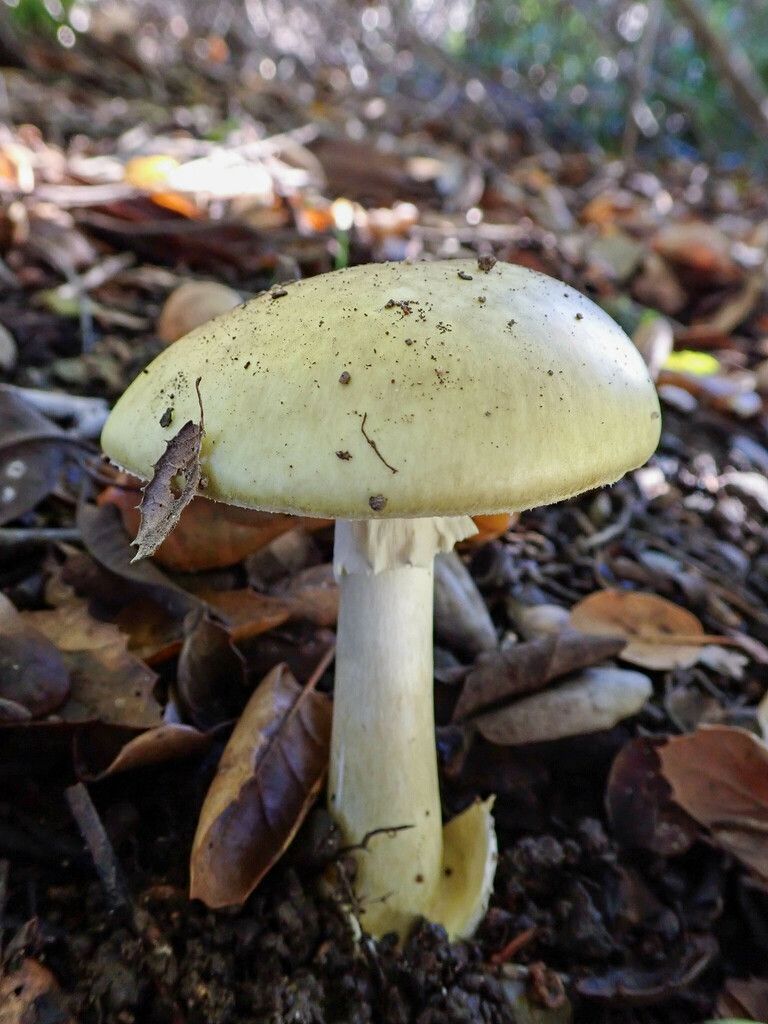
How to tell it
- Cap 2 to 6 inches across, greenish yellow to olive or bronze, smooth and sometimes shiny.
- White gills under the cap that do not touch the stem.
- A thin, skirt-like ring high on a white stem.
- A white cup or sac around the base of the stem, often hidden in the soil. You only see it if the whole mushroom is dug up.
- Grows on the ground near trees, especially oaks, often after rain.
Where you find it
Brought to the US on the roots of imported trees. CDC reports it is especially common in the San Francisco Bay Area in early winter, under coast live oak. It also grows in Oregon, Washington and scattered spots in the East.
Scientific name: Amanita phalloides
Look-alikes
An Asian food mushroom that looks much like a young death cap. Never pick a wild mushroom because it resembles one you know from another country.
These have pink to brown gills and no cup at the base, but a young one still in its egg can fool anyone.
A young Amanita in its egg can look like a puffball. Cut it top to bottom: a puffball is solid white inside, while an Amanita egg shows the outline of a cap and stem.
Why it is dangerous
Its poisons destroy the liver. CDC reported 14 poisonings in Northern California in December 2016; three people needed new livers. Symptoms (vomiting and diarrhea) start 6 to 24 hours after eating, can seem to improve a day later, and liver failure follows in 3 to 5 days. Cooking, drying and freezing do not remove the poison.
What to do
- If anyone ate a wild mushroom that could be a death cap, call the Poison Help line or go to an emergency room right away. Do not wait for symptoms.
- Keep any leftover mushroom, or dig up and bag a matching one with the base, for identification.
- Tell doctors when it was eaten. Early treatment matters most.
The free app reads your photo, names the likely match, shows its look-alikes, and tells you what has been seen near your ZIP code.
Sources
- US Army Survival Manual, page 128
- CDC MMWR: Amanita phalloides poisonings, Northern California, December 2016
Written in our own words from these public sources.