Look for long, strong fibers: the inner bark of dead basswood (linden), elm, cedar, hickory, white oak or mulberry, and the stalks of dogbane, milkweed and stinging nettle after they dry in fall. Strip a little and test it before you collect a lot.
Camp and wildlife · Camp and wildlife course
Make cord from plants and bark
If you have no rope, plants can make it. Long, stringy fibers from inner barkbark slabs Big sheets of bark peeled off a dead log. Laid like shingles, bottom row first, they shed rain. and some plant stems twist into cord strong enough for lashing a shelter, a snaresnare A trap made of a loop of wire or cord that tightens around an animal that walks or pokes its head through. triggertrigger The part of a trap that holds tension until the animal moves it. The heart of every trap. Practice it, then take it apart. or a fishing line. The trick is the reverse wrapreverse wrap The twist-and-wrap method for making cord from plant fiber. Each strand is twisted one way and wrapped the other, so the cord locks itself together.: two strands twisted one way and wrapped the other way so they lock together.
Why this matters
Cord holds shelters together, sets snare triggers, makes fishing line and ties splintssplint A stiff support, like sticks or rolled-up magazines, tied along a hurt arm or leg so it cannot move.. If your bag is lost or your rope is used up, you can make more from plants that grow almost everywhere.
The survival manual's test is simple: if a fiber survives a pull, a twist and an overhand knot, it will make cord.
What you need
- Inner bark of dead basswood, cedar or elm, or dry stalks of dogbane, milkweed or nettle (gloves for nettle).
- A knife to scrape bark, and a bucket of water for soaking.
About an hour to make an arm's length of cord the first time; much faster with practice.
Step by step
Test before you work: pull a strand hard. Then twist it between your fingers and roll the fibers together. If it does not snap, tie an overhand knot in it and tighten gently. If the knot holds, the fiber will make cord.
Clean the fibers: scrape off the outer bark or the woody center of a stalk so only the long strings are left. Soaking bark in water for a few days loosens the inner layer.
Reverse wrap: take a bundle as long as your arm and fold it so one side is longer than the other. Pinch the fold. Twist the top strand away from you, then wrap it toward you over the bottom strand. Now the bottom strand is on top. Repeat: twist away, wrap toward you.
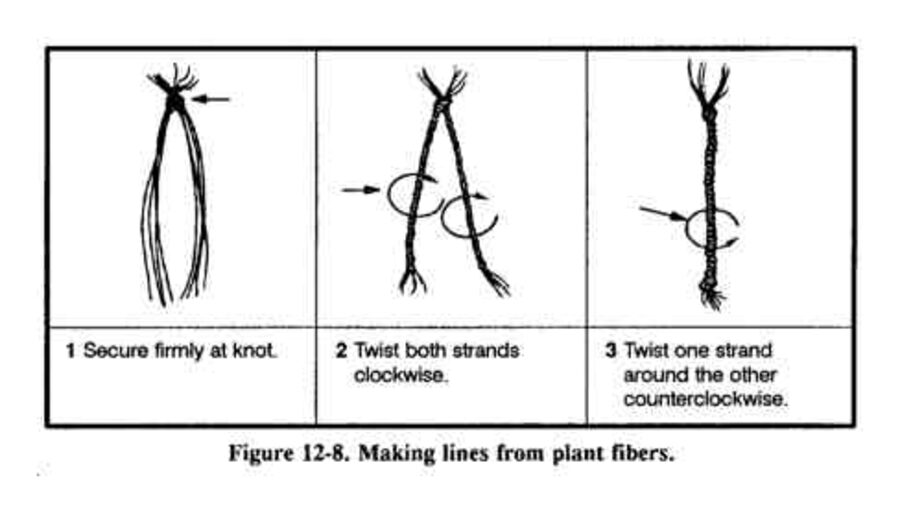
Twist each strand one way, then wrap them the other way Splice in new fibers before a strand runs out. Lay a new bundle alongside the short end and keep twisting both together. Because the two sides were uneven, the splices do not land in the same place, which keeps the cord strong.
Make it stronger by braiding three cords together, or by reverse wrapping two finished cords into one thicker cord.
Other sources of cord: unravel a woven belt, a shoelace or the threads of a sock or a tarp edge. The inner strands of 550 parachute cord each make a fine line.
Use it wet or dry? Plant cord is strongest when slightly damp while you work it. Lash things tight; most fibers shrink a little and tighten as they dry.
Tips from survival instructors
- Dogbane and milkweed stalks are best gathered dry in late fall and winter, when the fibers peel off easily.
- Braid three cords together when you need extra strength, like for a shelter ridgelineridgeline The long top edge of a hill or a chain of hills, like a spine, with land dropping away on both sides..
Common mistakes
- Using green or rotten fibers. The fix: test first; good fiber does not crumble or snap.
- Twisting and wrapping the same direction. The fix: twist away from you, wrap toward you, every time.
- Splicing both sides in the same spot. The fix: keep one side longer so splices are staggered.
- Stripping bark from live trees. The fix: use dead or fallen wood and dry plant stalks in fall.
Practice it safely
Practice the reverse wrap with yarn or string first, then try dry grass or dogbane stalks from a field edge in fall (with permission). Test your finished cord by hanging a full water bottle from it.
Quick check
Why make one side of the folded bundle longer?
- So the splices do not line up and weaken the cord
- It looks nicer
- So it is easier to cut
Show the answer
So the splices do not line up and weaken the cord
Take the quiz and earn the badge
The app checks your answers, keeps your place in the Camp and wildlife, and works with no signal once saved.
Before you rely on thisA learning tool, not a replacement for training. In an emergency, call 911.
Sources
Photo credits
Photo: US Army, FM 21-76 Survival (1992), Public Domain, source